
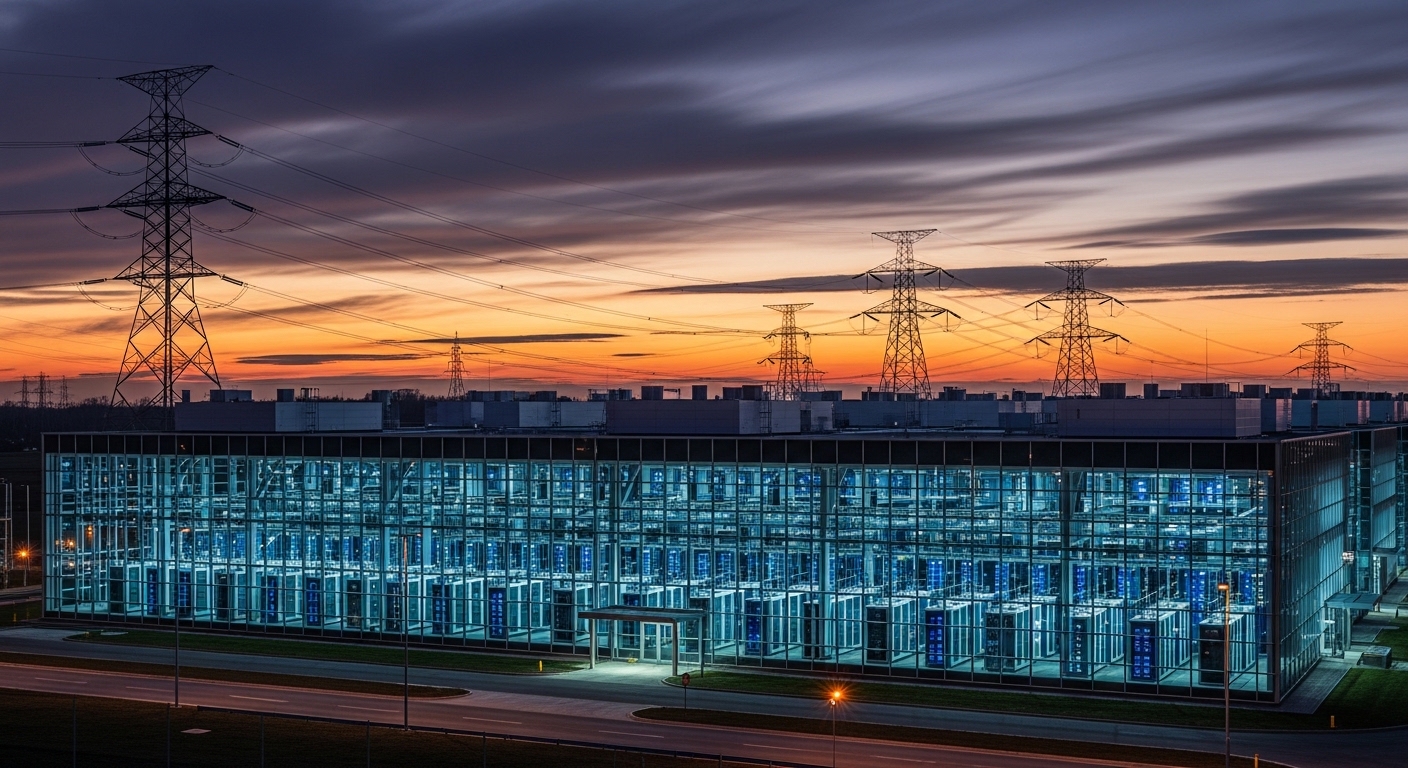
The J.P. Morgan Global PMI Composite Output Index reached 52.5 in January, signaling a world that is moving with a frantic, friction-heavy momentum. This acceleration is not the smooth glide of a healthy machine, but the rattling vibration of a system pushed beyond its designed tolerances. As of 9, , the global landscape is dominated by high demand for power and a fundamental scarcity of the physical infrastructure required to move it. We are witnessing a collision between the ephemeral world of artificial intelligence and the stubborn, unyielding reality of copper and steel.
The silicon hunger
In the last twelve months, the projection for data center power consumption has been revised upward with a frequency that suggests a loss of control. In some jurisdictions, the energy required to train and maintain generative models is no longer a rounding error in national budgets; it is a primary driver of policy. Current estimates suggest that data center power demand will increase by 17 percent annually through the end of the decade. This represents a massive transfer of resources from the public commons to the private server farm.
The pressure is most acute in the Asia-Pacific region, where a 4 trillion dollar investment boom is currently underway to keep the lights on. Yet, even with these astronomical sums, the timeline for grid expansion remains measured in years, while the timeline for AI deployment is measured in weeks. This mismatch has created a new class of "power orphans"—industries and residential developments that find themselves at the back of the queue for electricity hookups because a hyperscale facility has claimed the local capacity.
The end of the solar honeymoon
For a decade, the narrative of the energy transition was one of consistent, linear progress. That story just ended. For the first time in the modern era, annual solar installations are projected to decline. In China, which has long been the primary engine of renewable growth, a shift from guaranteed pricing to competitive bidding has cooled the market. This isn't just a regulatory hiccup; it is a signal that the easy gains of the green transition have been harvested.
What remains is the "hard" transition: the expensive, politically fraught process of building long-distance transmission lines and massive battery arrays to handle the intermittent nature of renewables. The cost of transmission and distribution is expected to rise by 20 percent by 2030. These costs are rarely borne by the tech giants driving the demand; they are filtered down to the average ratepayer, creating a quiet but profound socio-economic strain.
The sovereignty of the spark
Energy security has returned as a dominant theme of statecraft, but with a digital twist. Governments are increasingly treating electricity not just as a utility, but as a strategic asset essential for "Sovereign AI." If a nation cannot power its own models, it cannot claim to be a first-rate power in the coming decade. This has led to a revival of interest in nuclear power and "hydrogen-ready" infrastructure, such as the Horizon X high-speed ferry project currently beginning construction in the Philippines. These projects represent a desperate attempt to diversify away from the fragility of the traditional grid.
The cost of the compute
We are living through a period where the "K-shaped" economy is manifesting in the very wires above our heads. On one side, we see the rapid build-out of high-tech corridors powered by dedicated substations. On the other, we see aging municipal grids struggling with "grid congestion" and the rising physical risks of climate change. The World Economic Forum now ranks geoeconomic confrontation as the top global risk, and nowhere is that confrontation more visible than in the fight over the critical minerals and energy required to sustain the digital age.
The invisible hand of the market is currently being replaced by the heavy hand of industrial policy. From Washington to Beijing, the era of laissez-faire energy management is being discarded in favor of a model where the state picks winners in the race for electrons. The true cost of our digital life is finally appearing on the invoice, and it is higher than anyone expected.
Frequently Asked Questions
Why is global energy demand rising so quickly right now?
The primary drivers are the rapid electrification of transport and the unprecedented expansion of data centers required for AI. While traditional industrial growth remains steady, the "compute" requirement of modern technology creates a constant, high-baseline demand that traditional grids were not designed to support.
Is the decline in solar installations a sign that green energy is failing?
No, it is a sign of market maturation. After years of record-breaking growth, the industry is facing bottlenecks in the supply chain and grid integration. The "first wave" of easy solar adoption is over, and the next phase requires more complex infrastructure like large-scale battery storage and modernized transmission lines.
What is "Sovereign AI" and why does it matter for energy?
Sovereign AI refers to a nation's ability to develop and run its own artificial intelligence infrastructure without relying on foreign providers. Because AI requires massive amounts of power, achieving digital sovereignty now requires a guaranteed, domestic energy supply that can be shielded from global market shocks.
How does grid congestion affect the average consumer?
Grid congestion often leads to higher electricity prices and delays in new construction. When the existing wires cannot carry more power, utility companies must invest in expensive upgrades, the costs of which are typically passed on to consumers through increased monthly rates.



Comments
0 commentsLeave a Comment
No comments yet. Be the first to share your thoughts!